
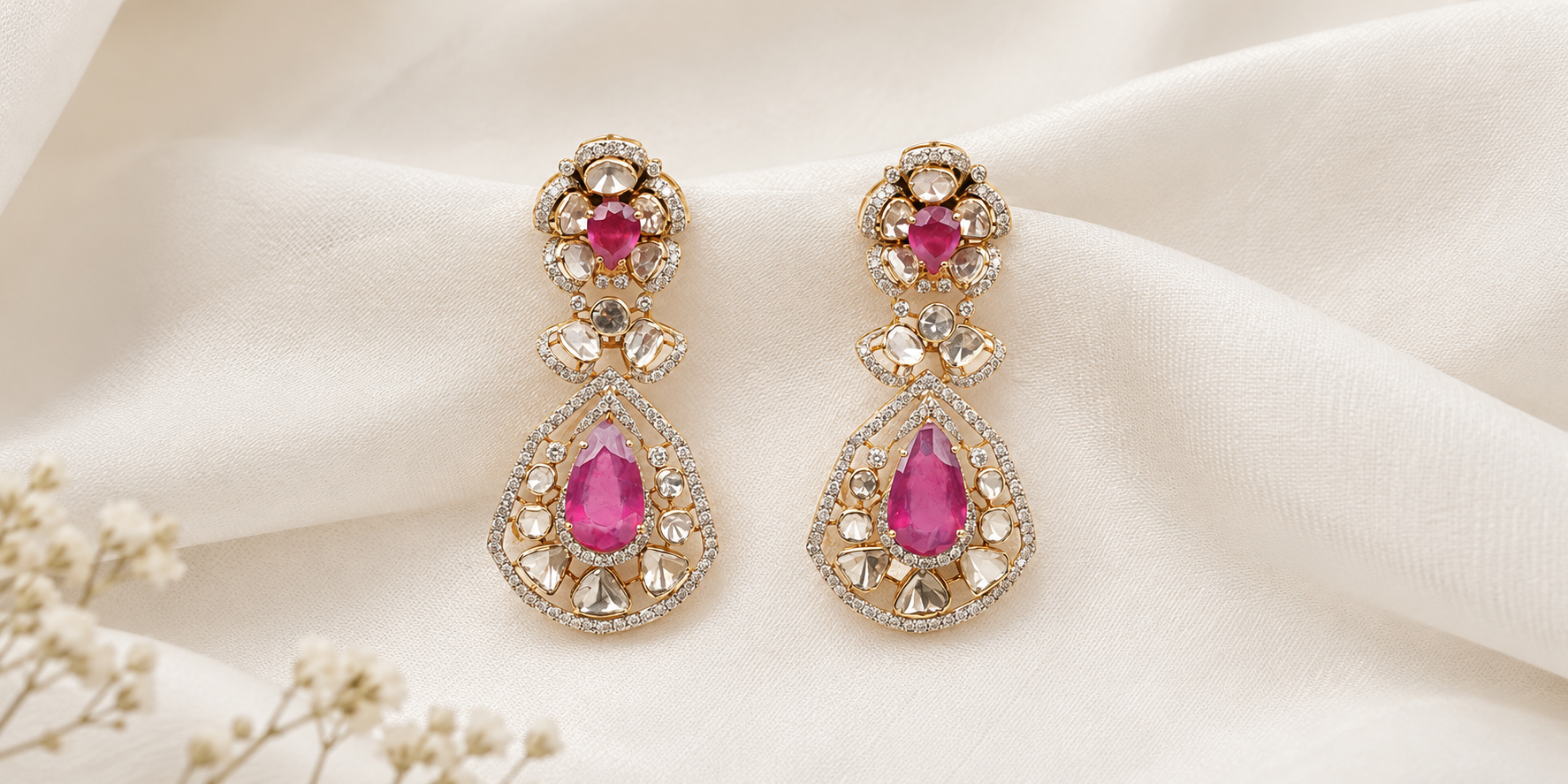
A Complete Guide to Diamond Jewellery: Types, Settings & What to Look For
Diamond jewellery covers a wide range of types, settings, and price points. Here is a complete guide to understanding what you are buying, what to look for, and how to choose the right piece.
Diamond Jewellery Explained: Types, Settings and What to Look For Before You Buy
Diamond jewellery is one of the most searched jewellery categories and, for many buyers, also one of the most confusing. Most people know they want a diamond piece. Fewer know what type of setting to ask for, what IGI certification actually tells you, or what the 4Cs mean in practice when you are standing in front of a display case.
This guide cuts through that confusion. Whether you are buying diamond jewellery for the first time, exploring options for a bridal purchase, or simply want to understand what you are looking at when you shop, here is everything that actually matters.
Types of Diamond Jewellery
Diamond jewellery spans a wide range of pieces, from small everyday studs to elaborate bridal sets. Here is a quick overview of the main categories.
Diamond Necklaces and Sets
Diamond necklaces range from simple solitaire pendants on a fine chain to elaborate multi-strand sets designed for bridal or occasion wear. A diamond jewellery set typically includes a coordinated necklace and earring pair, sometimes with a ring or bangle added, designed to be worn together for a unified look.
Diamond Earrings
Diamond earrings are one of the most versatile categories. Stud earrings with a single stone are popular for everyday wear, while longer drop earrings, hoops, and diamond jhumkas suit occasion wear and bridal looks. For South Indian bridal styling, diamond jhumkas and drops are often chosen to complement heavier gold necklace sets.
Diamond Rings
Solitaire rings, where a single diamond is set as the centrepiece, are the most classic diamond ring design. Other options include eternity bands, where diamonds run along the full or partial circumference of the ring, and cocktail rings with a larger central stone surrounded by smaller accent diamonds.
Diamond Bangles and Bracelets
Diamond bangles suit both everyday and occasion wear. Tennis bracelets, which feature a continuous line of diamonds in a channel or prong setting, are a popular choice. Heavier diamond bangles with more elaborate settings are often worn as part of a bridal jewellery stack.
Diamond Jewellery Sets
For bridal and occasion wear, a coordinated diamond set that spans necklace, earrings, and sometimes a Nethi Chutti or bangles brings a unified design language to the look. Diamond sets in South India are often worn alongside traditional gold bridal pieces, with our guides on bridal gold necklace set designs and kundan bridal jewellery sets covering how this layering works in practice.
Understanding Diamond Cuts and Shapes
Two terms that often get confused when buying diamond jewellery are cut and shape.
Cut vs Shape: What Is the Difference?
Shape is the physical form of the diamond: round, oval, princess, and so on. Cut refers to the quality of the diamond's faceting, specifically how precisely the facets are angled and finished to reflect light. Cut is one of the most important quality factors in a polished diamond because it directly determines how much the stone sparkles.
Common Diamond Shapes in Indian Jewellery
Round brilliant diamonds are the most popular choice for Indian jewellery, valued for their light return and versatility across settings. Princess cut (square), cushion cut (rounded square), pear, and marquise shapes are also commonly seen, particularly in rings and pendants.
What About Polki (Uncut) Diamonds?
Polki diamonds are a separate category entirely. Unlike faceted diamonds, polki stones are natural uncut or minimally cut diamonds that retain their original flat, irregular form. They are traditionally set using the jadau technique and give a warm, glowing look rather than the sharp sparkle of a polished cut diamond. Our complete guide to polki jewellery covers this in detail.
Diamond Jewellery Settings Explained
The setting is the way a diamond is held within the jewellery. It affects how the stone looks, how much light it receives, and how securely it is held.
Prong Setting
The most common setting for diamond jewellery. Small metal claws, usually four or six, hold the diamond in place while allowing maximum light to enter from all sides. Prong settings give diamonds strong brilliance but require periodic checking to ensure the prongs remain secure.
Bezel Setting
A thin metal rim encircles the diamond and holds it in place. Bezel settings are more protective than prong settings, making them well suited to everyday wear pieces like rings and bangles.
Pavé Setting
Small diamonds are set closely together across the surface of the metal, secured by tiny prongs. Pavé settings create a surface that appears almost entirely covered in diamonds and are common in bands, bangles, and as accent details around a central stone.
Channel Setting
Diamonds are set in a row within two parallel metal rails, with no prongs visible. Channel settings are particularly common in eternity bands and diamond bangles, giving a clean, streamlined look.
Halo Setting
A central diamond is surrounded by a ring of smaller accent diamonds, which makes the central stone appear larger and increases the overall sparkle of the piece. Halo settings are popular in engagement rings and pendants.
What Is IGI Certification and Why Does It Matter?
IGI certification is an independent grading report issued by the International Gemological Institute that verifies a diamond's Cut, Colour, Clarity, and Carat weight.
For buyers, this matters for one simple reason: a certificate is an independently verified record of what you are buying, not just the jeweller's description of it. Without certification, there is no way to objectively verify the quality claims made about a stone.
At Arabian Gold and Diamonds, all diamond jewellery carries IGI certification, giving buyers a clear, documented record of each stone's quality alongside BIS 916 hallmarking on the gold components.
The 4Cs of Diamonds: A Simple Breakdown
The 4Cs, Cut, Colour, Clarity, and Carat, are the internationally accepted framework for grading diamond quality. Here is what each one means in practice.
Cut
Cut is the most important of the 4Cs for determining how much a diamond sparkles. A well-cut diamond reflects light efficiently from facet to facet, producing the brilliance most people associate with diamonds. A poorly cut diamond of high colour and clarity will still look dull if the facets are not angled correctly.
Colour
Diamond colour is graded on a scale from D (completely colourless) to Z (a noticeable yellow or brown tint). For most Indian jewellery settings, particularly yellow gold, diamonds in the G to H range offer excellent value: the colour difference from a D is negligible to the eye, but the price difference is significant.
Clarity
Clarity refers to the presence of internal inclusions or external blemishes in the diamond. Clarity grades run from Flawless down to Included. For most buyers, an eye-clean stone, one where inclusions are not visible to the naked eye, is a practical target. VS2 to SI1 grade stones typically meet this standard without a premium price.
Carat
Carat is the unit of weight for diamonds, not size. A higher carat diamond is heavier, but two diamonds of the same carat weight can look quite different in size depending on their cut and shape. Carat weight is best understood alongside the other three Cs rather than in isolation.
Diamond Jewellery for Everyday Wear vs Occasion Wear
Not all diamond jewellery is designed for the same purpose, and the setting and style choices that make sense for bridal wear are different from those suited to daily use.
Everyday Diamond Jewellery
For daily wear, bezel and channel settings are more practical because they protect the diamond more fully and are less likely to catch on clothing. Lighter pieces, such as small stud earrings, a simple solitaire pendant, or a slim diamond bangle, wear comfortably across a full day. BIS 916 hallmarked gold in the setting ensures the metal holds up well over time.
Occasion and Bridal Diamond Jewellery
For bridal and occasion wear, larger, more elaborate designs with pavé, halo, and prong settings bring the maximum visual impact. In South Indian bridal styling, diamond necklace sets, diamond jhumkas, and diamond-accented Nethi Chutti are often chosen to work alongside heavier gold pieces, giving the overall look depth and contrast.
What to Check Before Buying Diamond Jewellery
A few questions worth asking before any diamond jewellery purchase.
Ask for IGI Certification
Any reputable jeweller selling diamond jewellery should be able to provide IGI certification for the stones. If a piece does not come with a certificate, ask why before proceeding.
Check BIS 916 Hallmarking on the Gold
The gold used in the setting should carry BIS 916 hallmarking, certifying 91.6 percent purity with a HUID number that makes the piece individually traceable.
Understand Making Charges
Making charges on diamond jewellery can vary significantly between jewellers and designs. Always ask for a clear breakdown of the making charge separate from the stone value and gold weight, so you know exactly what you are paying for.
Buy from a Trusted Source
Arabian Gold and Diamonds has been operating since 1994. All diamond jewellery we stock carries IGI certification and BIS 916 hallmarked gold, giving buyers both independent stone verification and certified metal purity in the same piece.
Frequently Asked Questions About Diamond Jewellery
What is the difference between diamond jewellery and polki jewellery?
Diamond jewellery typically uses faceted, polished diamonds cut to maximise brilliance. Polki jewellery uses natural uncut or minimally cut diamonds in their original form, set using the traditional jadau technique. The two produce quite different looks: polished diamonds sparkle sharply, while polki stones glow warmly.
What does IGI certified diamond jewellery mean?
IGI certified diamond jewellery means the diamonds in the piece have been independently graded by the International Gemological Institute and issued a report verifying their Cut, Colour, Clarity, and Carat weight. It is the buyer's assurance that the quality claims on the stone are independently verified.
Which diamond cut is best for Indian jewellery?
Round brilliant is the most popular cut for Indian jewellery because it maximises light return and suits a wide range of settings and styles. That said, the best cut depends on the piece: princess and cushion cuts work well in rings, while pear and marquise shapes are often used in pendants and drops.
Is diamond jewellery a good investment?
Diamond jewellery holds value through both the diamond and the gold in the setting, but its primary value is as jewellery rather than a financial instrument. IGI certification and BIS 916 hallmarking ensure both the stone and the metal are genuinely what they are certified to be, which protects the buyer's investment over time.
How do I choose diamond jewellery for daily wear?
Look for secure settings such as bezel or channel rather than prong settings, lighter designs that are comfortable to wear, and BIS 916 hallmarked gold in the setting. Small stud earrings, simple solitaire pendants, and slim diamond bangles are all practical starting points for everyday diamond jewellery.
Final Thoughts
Buying diamond jewellery with confidence comes down to understanding three things: what type of piece suits the occasion, what setting holds the stone securely for how you plan to wear it, and what IGI certification and BIS 916 hallmarking actually guarantee. With those three covered, the choice becomes much simpler.
If you would like to explore IGI certified diamond jewellery in person, our TAHOR collection is available at our showrooms in Edapally, Kochi and Pathanamthitta. You are also welcome to reach out on WhatsApp to arrange a consultation ahead of your visit.