
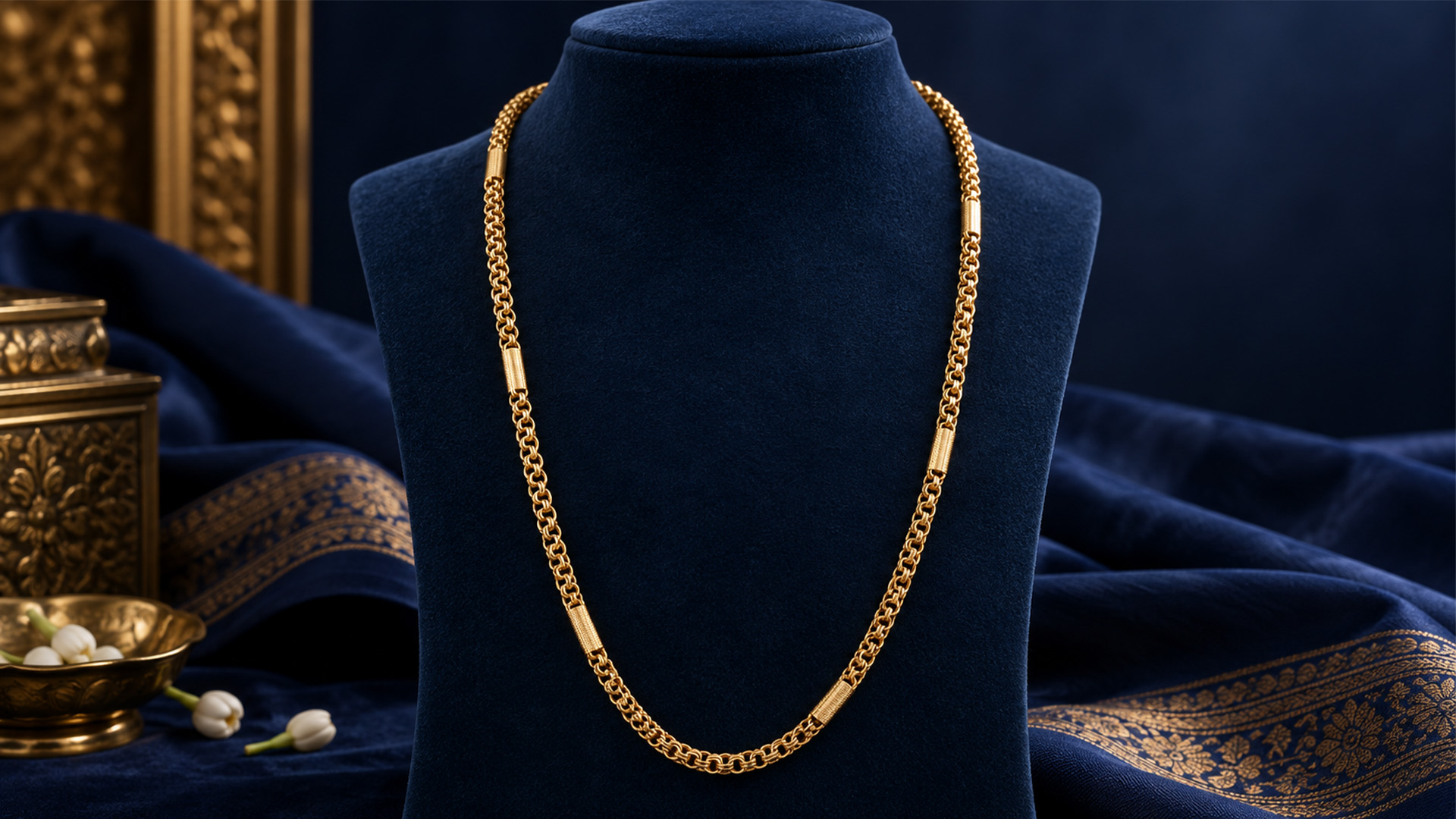
South Indian Gold Chains: Lotus Chain, Nagapadam Mala, Manga Mala and More
South Indian gold jewellery has a set of chain designs that are entirely its own — from the lotus chain and nagapadam mala to the manga mala and kayarupiri. Here is what each one is and how to choose.
South Indian Gold Has Its Own Chain Vocabulary. Here Is What Each One Means.
If you search for gold chain designs, most of what comes up is generic: Cuban links, rope chains, box chains, figaro. These are internationally common designs available from any gold jeweller in any part of the world.
South Indian gold jewellery has its own chain vocabulary. The lotus chain, the nagapadam mala, the manga mala, the kayarupiri, the karimanimala — these are designs specific to the South Indian tradition, with specific names in Malayalam and Tamil, and specific cultural contexts for when they are worn and how. They are not regional variations of something else. They are their own forms, with their own histories.
This guide covers the most significant traditional South Indian gold chains, what each one is, how it is constructed, and what occasions it belongs to. All the pieces discussed here should carry BIS 916 hallmarking certifying 91.6 percent gold purity with a HUID traceability number — and at Arabian Gold and Diamonds, that applies across the full range of South Indian chain designs.
The Lotus Chain
What Is A Lotus Chain
A lotus chain is a gold chain in which the links are shaped to suggest a lotus petal, or in which lotus flower motifs are incorporated at intervals along the chain. The lotus form is one of the most significant symbols in South Indian culture and temple tradition — it appears on temple carvings, in classical dance, and across every category of South Indian jewellery. Its consistent presence in gold chain design is not a decorative coincidence. It reflects the flower's cultural weight in the tradition.
Lotus chains are available across a wide range of weights and gauges. A fine-gauge lotus chain in BIS 916 gold sits lightly at the collarbone and works as an everyday piece. A heavier lotus chain with larger, more defined petal links is a statement piece suited to festival and occasion wear.
Lotus Chain Design Variations
The most common lotus chain design uses flat, leaf-shaped or petal-shaped gold links arranged so that the chain lies smooth and wide against the skin. Each link overlaps slightly with the next, creating a continuous petal-on-petal surface that catches light differently from a plain link chain.
A second common design places small three-dimensional lotus flower elements at intervals along a fine chain — either as repeated motifs across the full length, or as a single central lotus (the lotus dollar chain) from which the chain extends on either side. The lotus dollar chain is one of the most popular everyday pendant necklace options in South Indian gold jewellery, working well with both traditional dress and contemporary outfits.
Some lotus chain designs incorporate small hanging elements beneath each petal link, adding gentle movement to the chain when worn.
When and How the Lotus Chain Is Worn
As an everyday chain, a fine lotus gold chain worn at the collarbone is a practical and considered choice. The design is recognisably South Indian without being ceremonial in weight or scale.
For festival occasions such as Onam, Vishu, and Akshaya Tritiya, a heavier lotus chain worn as a stand-alone statement necklace is appropriate. For traditional layered looks, a lotus chain at the collarbone pairs well with a longer manga mala or a Kasu Mala at the mid-chest.
Nagapadam Mala
What Nagapadam Means
A nagapadam mala is a South Indian gold chain featuring cobra hood motifs — "nagapadam" translates to cobra hood in Malayalam. The spread hood of the cobra is a form with deep significance across South Indian temple, devotional, and classical arts traditions. Naga (serpent) iconography appears throughout South Indian temple architecture, in Nagaraja worship, and in classical dance forms. The nagapadam mala is the jewellery expression of that visual and cultural tradition.
The cobra hood motif in nagapadam mala design is typically rendered as a flat, fan-shaped element at the top of each pendant unit, with a narrow neck below. Arranged in a line across the chain, these elements create a distinctive silhouette that is immediately recognisable to anyone familiar with South Indian jewellery.
Design, Weight, and Occasions
Nagapadam malas are generally more substantial in weight than everyday chains. The cobra hood motifs require more gold per unit of length than a standard link chain, and the design reads as a ceremonial or occasion piece rather than an everyday one. Most nagapadam malas are produced in antique gold finish or in plain 22-karat BIS 916 gold, with the antique finish being particularly effective at bringing out the depth and detail of the cobra hood form.
The nagapadam mala is worn for temple visits, Onam and other major South Indian festivals, traditional ceremonies, and as part of a bridal jewellery look that draws on classical South Indian design. It pairs naturally with a Kerala kasavu saree or a Kanchipuram silk, and sits as a necklace-length piece at the collarbone to upper chest.
Manga Mala
What Manga Mala Means
A manga mala is a South Indian gold chain featuring mango-shaped motifs — "manga" is the Malayalam and Tamil word for mango. The mango form is one of the oldest recurring motifs in South Indian visual culture. It appears on temple architecture, on the borders of silk sarees, on brass lamps, and in classical dance costumes. What the Western world knows as the paisley motif is derived from this same mango form, transliterated through trade and textile history. The manga mala is the jewellery expression of the mango motif in its original South Indian context.
Each mango unit in a manga mala is a small, teardrop-shaped gold element, wider at the base and tapering to a curved point at the top. The units are typically connected by small rings or bails and arranged in a continuous line around the neck, with the flat face of each mango motif resting against the skin.
Design Variations and Occasions
Plain gold manga malas in BIS 916 gold are available in a range of mango motif sizes, from small and delicate to large and statement-making. Smaller motif manga malas work as everyday and festival pieces. Larger motif manga malas are bridal and ceremony pieces.
Antique finish manga malas, where the recessed areas of the mango motif are oxidised to a darker tone that contrasts with the raised gold surface, are particularly popular for bridal and traditional occasion wear. The finish brings out the carved or pressed detail of the mango form in a way that polished gold does not.
Stone-set manga malas, with kemp stones, rubies, or emeralds set into the mango motifs, are bridal pieces. A ruby-set manga mala worn with a matching ruby-set necklace and jhumkas is one of the classic expressions of a South Indian bridal gold look.
The manga mala pairs naturally with the Palakka Mala, the Mullamottu Mala, and the Kasu Mala in a layered South Indian jewellery look. It also layers well with a nagapadam mala for a full traditional necklace stack.
Karimanimala
A karimanimala is a South Indian chain of small black beads interspersed with gold elements — "kariman" refers to the small black glass or stone beads that give the chain its characteristic two-tone appearance. The alternating black beads and gold beads or gold caps create a distinctive visual rhythm that plain gold chains do not have.
In some South Indian communities, the karimanimala carries significance as a marriage necklace, functioning similarly to the mangalsutra in other traditions. As everyday jewellery, it is worn for its visual character and its cultural familiarity, particularly among women who want a traditionally South Indian piece for daily use without the weight or scale of a heavier gold chain.
Contemporary karimanimala designs sometimes use elongated gold tubes or small gold cylinders between the black beads, updating the proportion of the traditional design while keeping the essential two-tone character. The karimanimala is typically worn at a shorter length, sitting at the throat or collarbone.
Kayarupiri Chain
A kayarupiri chain is a twisted gold chain specific to the Kerala jewellery tradition. The name comes from "kayar," the Malayalam word for coir — the natural fibre made from coconut husk that has been twisted into rope for centuries in Kerala. The kayarupiri chain takes its visual character from that twisting: two or more strands of fine gold wire or fine gold chain are twisted together along the full length, creating a textured rope surface that is entirely different from the smooth surface of a standard link chain.
The kayarupiri is one of the most distinctly Kerala-specific gold chains available, and for that reason it carries a regional character that generic chain designs do not. It works well as an everyday chain given its comfortable weight and the way it sits flat against the skin, and it layers naturally with other South Indian chains for a more traditional look.
Muthumala
A muthumala is a South Indian pearl chain — "muthu" is the Malayalam and Tamil word for pearl. In its traditional form, the muthumala is a single strand of real or cultured pearls with a gold clasp, or a combination of small pearls and gold beads strung on a single line. Some versions alternate small gold beads with pearls across the full length of the chain; others use a plain pearl strand with gold elements at the clasp and ends only.
In South Indian weddings, the muthumala is a traditional bridal piece worn alongside gold necklaces as part of the full bridal jewellery layer. It adds a different texture and quality of light to the bridal look that gold alone does not — the soft, diffused light of a pearl against the warm reflectiveness of 22-karat gold creates a contrast that has been part of South Indian bridal jewellery for centuries.
Where the muthumala incorporates gold beads, clasps, or spacers, those elements should carry BIS 916 hallmarking. When buying a muthumala with gold elements, ask to see the hallmark on the gold components before purchase.
How to Choose the Right South Indian Gold Chain
Match the Chain to the Occasion
For everyday wear, a fine-gauge lotus chain, a lotus dollar chain, a kayarupiri chain, or a karimanimala are all practical choices. They are light enough to wear through a full day and carry enough South Indian character to feel considered rather than anonymous.
For festivals, temple occasions, and family ceremonies, a heavier lotus chain, a nagapadam mala, or a manga mala in a larger motif size is appropriate. These pieces are designed to be seen and to carry their visual weight across a public occasion.
For bridal use, the manga mala, nagapadam mala, and muthumala are the anchor pieces of a traditional South Indian bridal necklace layer, worn alongside Palakka Mala, Mullamottu Mala, and Kasu Mala for the full layered look. Our guide to bridal gold necklace set designs covers how to build that layer in detail.
Think About Layering
South Indian jewellery is a layering tradition. These chains are not typically worn in isolation — they are worn in combination, at different lengths, with different visual characters that complement rather than compete. A lotus chain at the throat, a manga mala at the collarbone, and a longer nagapadam mala or Kasu Mala at the mid-chest creates a graduated layered look that is distinctly and specifically South Indian.
When choosing multiple chains to wear together, the key is variation in motif and length. Two chains of the same length and similar motif tend to look cluttered; two chains of different lengths with complementary motifs tend to look considered.
Check the BIS 916 Hallmark
Every gold chain, regardless of whether it is a lotus chain, a nagapadam mala, or a manga mala, should carry BIS 916 hallmarking certifying 91.6 percent gold purity with a HUID number that makes the piece individually traceable. This is particularly important when buying traditional South Indian chains, where the specific designs are sometimes replicated in lower-purity or gold-plated materials. At Arabian Gold and Diamonds, BIS 916 hallmarking applies across all gold jewellery including every South Indian chain design in the collection.
Frequently Asked Questions
What is a lotus chain in gold?
A lotus chain is a gold chain in which the links are shaped like lotus petals, or in which lotus flower motifs appear at intervals along the chain. It is one of the most popular South Indian gold chains for both everyday wear and festive occasions, available in a range of weights and gauges in BIS 916 hallmarked gold.
What is nagapadam mala?
Nagapadam mala is a South Indian gold chain featuring cobra hood motifs — "nagapadam" means cobra hood in Malayalam. It is a ceremonial and festival piece with deep roots in South Indian temple and devotional tradition, typically produced in antique gold finish or plain 22-karat BIS 916 gold, and worn for Onam, temple occasions, weddings, and traditional ceremonies.
What is manga mala and when is it worn?
Manga mala is a South Indian gold chain featuring mango-shaped motifs — "manga" is the Malayalam and Tamil word for mango. It is one of the most traditional South Indian gold chains, worn for weddings, festivals, and family ceremonies. It is available in plain gold, antique finish, and stone-set versions, and is a central piece in a traditional South Indian bridal jewellery look.
What is karimanimala?
Karimanimala is a South Indian chain of small black beads interspersed with gold elements. "Kariman" refers to the black beads, which alternate with gold beads or gold caps to create a distinctive two-tone chain. It is worn daily in some South Indian communities and carries significance as a marriage necklace in certain traditions.
How do I choose between South Indian gold chain designs?
Start with the occasion: lotus chains and kayarupiri chains work for everyday wear; nagapadam malas and manga malas are festival and ceremony pieces; the muthumala and stone-set manga mala are bridal pieces. Then consider layering — South Indian jewellery tradition wears multiple chains together at different lengths, and choosing chains that vary in motif and length gives the most balanced result.
Part of a Living Tradition
The lotus chain, the nagapadam mala, the manga mala, the karimanimala, the kayarupiri, and the muthumala are not nostalgic objects. They are in active use across South Indian weddings, festivals, and daily life. They have persisted because the forms are good — well considered, regionally specific, and designed to be worn rather than stored.
If you would like to explore South Indian gold chain designs in person, our showrooms in Edapally, Kochi and Pathanamthitta carry the full range of traditional South Indian chains in BIS 916 hallmarked gold. You are welcome to reach out on WhatsApp to arrange a visit or consultation before you come in.