
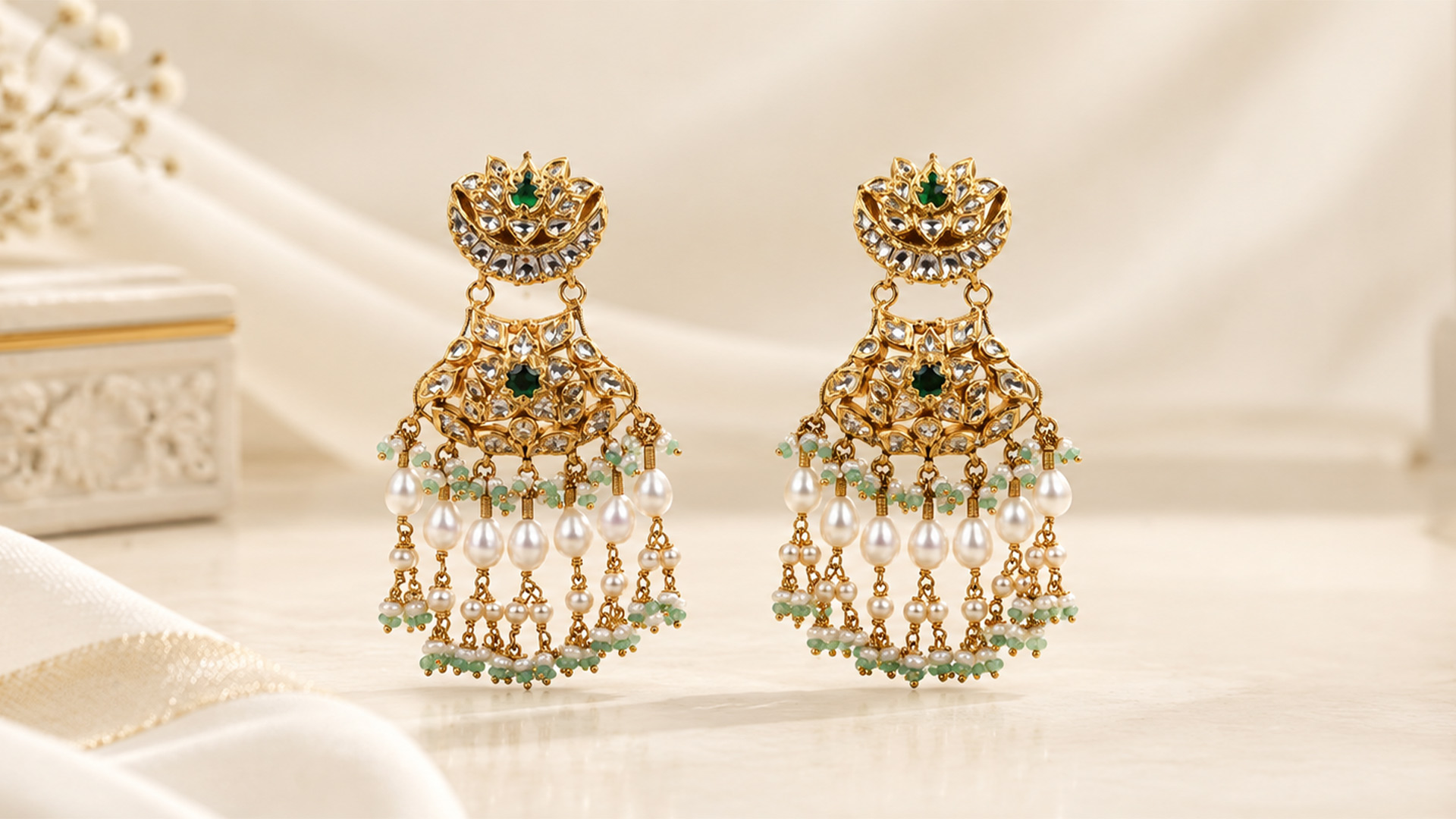
Bridal Gold Earrings: Styles and How to Choose the Right Pair for Your Wedding Look
The earring sits at face level in every photograph and frames the necklace from the other side. Getting it right matters more than most brides realise. Here is how to choose.
Your Bridal Gold Earrings Do More Work Than You Think
There is a moment in every wedding photograph where the camera finds the bride's face. In that frame, the earring is always visible. The necklace may be partially covered by a garland or the drape of the saree. The bangles may be out of shot. But the earring, sitting at face level, is always there, framing the jaw, catching the light, and completing or disrupting whatever the rest of the jewellery is trying to do.
Most brides make the earring decision last. The necklace comes first, then the other pieces fall into place, and the earring is chosen to match. That is not necessarily wrong, but it means the earring rarely gets the independent thought it deserves. The right bridal gold earring does not just match the necklace. It frames the face, balances the necklace from the other side, and holds its presence across hours of ceremony, photographs, and movement.
This guide covers the main bridal gold earring styles, how each one works with different necklaces, hairstyles, and ceremony types, and what to look for when you are choosing and buying. For brides building a full bridal jewellery look, our guide to bridal gold necklace set designs covers the necklace layer in detail, and our guide to kundan bridal jewellery sets is useful if you are working with a kundan or mixed-finish bridal set.
South Indian Bridal Gold Earring Styles
Gold Jhumkas: The Ceremony Earring
The jhumka is the default bridal earring across most South Indian wedding traditions, and for good reason. Its form, a domed upper section that narrows into a hanging bell or a series of small bells below, creates visual weight and movement that holds its own against the scale of a full bridal necklace stack. A well-made gold jhumka in BIS 916 hallmarked 22-karat gold catches light differently at every angle, which means it photographs well even under the mixed and variable lighting of a long ceremony.
Full, heavy jhumkas with stone setting, filigree work, or embossed temple motifs are the natural choice for the main wedding ceremony. These pieces are designed to be seen from a distance and to hold their presence across several hours. If you are wearing a full necklace stack, a layered haram, or a statement temple necklace, the jhumka needs to be substantial enough to balance it. A small or delicate earring next to a heavy necklace will look as though it belongs to a different look.
Midi jhumkas, lighter and slightly smaller than a full ceremonial pair, work well for reception events, engagement ceremonies, or the mehendi, where a full jhumka would be dressed too heavily for the occasion but a stud or simple drop would feel underdressed.
Chandbali Earrings: The Statement Crescent
The chandbali is named for its crescent or half-moon form. It is a flat, typically circular earring with a curved lower edge from which small drops or bells hang, creating a distinctive silhouette that is instantly recognisable.
In bridal gold jewellery, chandbali earrings offer a more dramatic visual footprint than a jhumka at the same weight. The wide crescent shape frames the jaw and cheekbone in a way that a hanging jhumka does not, which makes chandbali earrings particularly effective with hairstyles that pull the hair back or up, leaving the cheek and jaw fully visible. They also work well with deeper necklines and saree drapes that leave the neck bare on one side.
Chandbali designs in plain gold, antique finish gold, or gold with kemp stone setting are all common in South Indian bridal jewellery. The antique finish chandbali pairs naturally with temple jewellery necklaces and harams. A plain gold chandbali works across a broader range of necklace styles.
Long Gold Drops and Danglers
Long drop earrings fall in a vertical line from the ear rather than in the rounded or crescent forms of the jhumka and chandbali. They suit a specific combination of look: hair worn up or pinned, a neckline that leaves the neck visible, and a necklace that sits at the collarbone rather than layering up to the jaw.
In that combination, a long gold drop earring creates a clear vertical line on each side of the face that draws the eye downward toward the necklace rather than outward, giving the overall look a more elongated, composed quality. Danglers with layered gold sections, small gold bells at the end, or graduated drops of gold beads are popular bridal choices in this categor
Long drops are less practical than jhumkas for ceremonies that involve a lot of movement, touching the face, or wearing a veil or dupatta, because the length creates more opportunity for the earring to catch or swing. They are better suited to reception events or photography sessions where the bride has more control over movement.
Gold Studs for Lighter Events
A well-made gold stud is not a compromise in a bridal context. For the Haldi ceremony, the Seemantham, or a casual pre-wedding family gathering, a stud in BIS 916 gold with a meaningful stone or motif is entirely appropriate and often more comfortable for a long, active day than a heavy jhumka.
Some brides also choose to wear studs on the morning of the wedding while getting ready, switching to the full jhumka or chandbali once the jewellery layer is being applied. Keeping a pair of good-quality gold studs as part of the bridal jewellery set is a practical decision that most brides find useful across the range of events in a wedding calendar.
The Mattal: When to Consider It
The mattal is a chain that connects the jhumka to a pin in the hair or to a small ear cuff higher up the ear, distributing the weight of the earring and adding a layered decorative line from the ear to the hairline. It is a traditional South Indian jewellery element with a long history in classical dance jewellery and ceremonial wear, and it is increasingly chosen by brides who want to wear a substantial jhumka across a long ceremony without the discomfort of a heavy single-point earring.
Practically, the mattal shifts some of the jhumka's weight onto the hair rather than concentrating it entirely on the earlobe. For a wedding ceremony that runs several hours, this makes a meaningful difference. The mattal also adds a visual detail that is distinctly South Indian in character and photographs beautifully when the hair is worn up.
If you are considering a mattal, plan for it early rather than trying to add it on the day. The hair arrangement needs to account for the pin placement, and the earring itself should be chosen with the mattal in mind so that the length and weight are appropriate for the chain.
How to Choose Your Bridal Gold Earrings
Match the Earring to the Necklace
The weight and scale of the necklace is the first consideration. A heavy, multi-layer necklace stack reaching up toward the jaw needs a lighter or more compact earring, otherwise the face disappears between competing layers of gold on both sides. A single statement necklace worn alone, such as a long haram or a bold temple necklace, has more room to support a fuller jhumka or a wide chandbali.
The design motif matters as well. A temple motif necklace reads most naturally with a temple motif jhumka or chandbali. A plain gold necklace is more versatile and works with a broader range of earring designs. Mixing design motifs, such as a floral necklace with a geometric chandbali, can work, but it requires more care to ensure the two pieces feel considered rather than mismatched.
Match the Earring to Your Hairstyle
Hair worn up, pinned, or in a bun: the earring is fully visible from jaw to hair and can carry more visual weight. Full jhumkas, chandbali earrings, and long drops all work well here. If you are wearing a mattal, this is the hairstyle it requires.
Hair worn loose, curled, or draped across one shoulder: the earring may be partially or fully obscured by the hair. In this case, a shorter jhumka or a midi jhumka that sits clear of the hair tends to work better than a long drop or chandbali that disappears behind it. This is also where a stud paired with a strong necklace can be the right call — the necklace does the work, and the stud does not fight with the hair.
Match the Earring to the Ceremony
Main wedding ceremony: a full jhumka or chandbali earring in BIS 916 gold, with or without a mattal depending on hairstyle and personal preference.
Reception: a midi jhumka, a shorter drop, or a chandbali in a lighter weight. The reception often involves more movement and greeting than the ceremony, and a slightly lighter earring is more comfortable without looking underdressed.
Engagement or pre-wedding functions: a good midi jhumka or a well-chosen stud. The scale can step down from the main ceremony without stepping out of gold entirely.
What to Check When Buying Bridal Gold Earrings
BIS 916 Hallmarking
Every bridal gold earring should carry BIS 916 hallmarking, certifying 91.6 percent gold purity with a HUID number that makes the piece individually traceable. This applies to jhumkas, chandbali, drops, and studs equally. At Arabian Gold and Diamonds, BIS 916 hallmarking applies across all gold jewellery, including every piece in the bridal range.
Setting and Hook Quality
The hook or post that passes through the ear is the structural point that everything else depends on. On a jhumka or drop earring, the hook should be thick enough not to widen under the weight of the earring over a long day. On a stud, the post should be straight and the butterfly or screw back should grip securely.
For heavy jhumkas with stone setting, check that each stone is seated firmly in its setting before purchase. Stones that move or feel loose in the setting will not survive a long ceremony. If you are buying a pair with kemp stones, check the resin or wax setting quality — poorly set kemp stones will fall out under the warmth of close-body contact and movement.
Try the Weight Before You Decide
This sounds obvious but is often skipped in the excitement of selecting a bridal earring. Wear the earring for ten minutes in the showroom, moving normally and turning your head. A weight that feels fine in the first minute can feel uncomfortable in the tenth. Your ears will tell you clearly whether a pair is practical for a four-hour ceremony.
Frequently Asked Questions
What type of earrings are best for a bridal look?
For a main South Indian wedding ceremony, a full gold jhumka or chandbali earring in BIS 916 hallmarked gold is the most traditional and visually appropriate choice. The right style depends on the weight of the necklace, the hairstyle, and the length of the ceremony. For reception events or pre-wedding functions, a midi jhumka or shorter drop is a practical step down.
What is the difference between a jhumka and a chandbali earring?
A jhumka has a domed upper section and a hanging bell or bells below, creating a rounded, layered form with movement. A chandbali has a flat, crescent or moon-shaped body from which small drops hang, creating a wider, more graphic silhouette. A jhumka reads more traditionally; a chandbali reads more structured and statement-making.
Should bridal earrings match the necklace exactly?
They do not need to match exactly, but they should be coherent. The design motif, finish, and scale should feel like they belong in the same look. A temple motif necklace reads most naturally with a temple motif earring. A mismatch in motif or finish is more noticeable than a difference in exact design.
What is a mattal and should I wear one with my bridal jhumka?
A mattal is a chain connecting the jhumka to a hair pin or ear cuff higher up the ear. It distributes the earring's weight across the ear and hair rather than concentrating it at the earlobe, which makes heavy jhumkas more comfortable across a long ceremony. It also adds a traditional South Indian visual character. Whether to wear one depends on hairstyle, personal preference, and the weight of the earring chosen.
How do I choose bridal earrings for a reception versus the main ceremony?
For the main ceremony, choose your fullest and most statement pair, whether a heavy jhumka, a chandbali, or a long drop, matched to the scale of your necklace. For the reception, step down in scale rather than in quality: a midi jhumka or a shorter drop in the same finish keeps the look considered without the full weight of the ceremony earring across a longer, more active event.
The Right Pair at the Right Moment
A bridal earring is not a single decision. It is a series of decisions across every event in a wedding calendar, and the right pair for the ceremony is not always the right pair for the reception or the Haldi. Building a small, considered range of bridal gold earrings across different weights and styles gives you the flexibility to dress appropriately for each moment without compromising on gold quality or craftsmanship at any of them.
If you would like to explore bridal gold earring designs in person, our showrooms in Edapally, Kochi and Pathanamthitta carry a range of bridal earrings across jhumkas, chandbali, drops, and studs, all in BIS 916 hallmarked gold. You are welcome to reach out on WhatsApp to arrange a bridal consultation before your visit.