
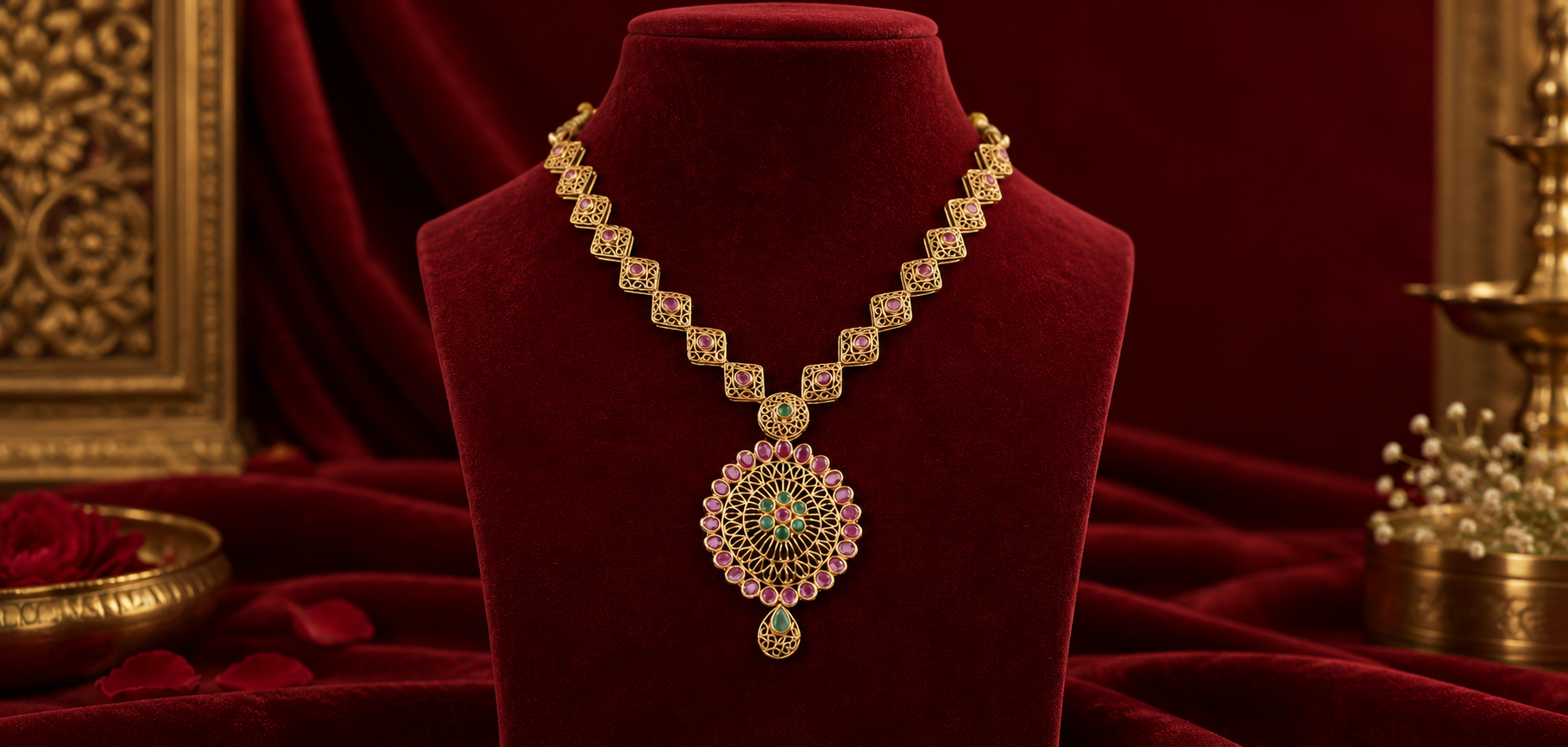
A Complete Guide to Precious Stone Jewellery: Names, Meanings & Buying Tips
Rubies, emeralds, sapphires, diamonds: precious stones have been set into jewellery for centuries. Here is a guide to what they are called, what they mean, and what to look for when buying.
Precious Stone Jewellery Explained: Names, Meanings and How to Choose the Right One
Precious stones have been part of Indian jewellery for centuries. From the kemp stones set into traditional South Indian temple pieces to the emeralds and diamonds used in bridal kundan sets, coloured gemstones and precious stones carry both visual richness and deep cultural meaning.
But for many buyers, the world of precious stone jewellery can feel complicated. What exactly makes a stone "precious"? What is the difference between a ruby and a kemp stone? And what should you actually check before buying?
This guide answers all of those questions, covering the names and meanings of the four precious stones, how they differ from semi-precious stones, how they are used in Indian jewellery traditions, and what to look for when buying precious stone jewellery.
If you are also interested in how precious stones like emeralds feature in bridal jewellery sets, our guide on kundan bridal jewellery sets covers this in the context of South Indian and North Indian bridal styling.
What Are Precious Stones?
Precious stones are a group of four gemstones, diamond, ruby, emerald, and sapphire, classified separately from all other gemstones due to their rarity, hardness, and historical value.
These four have been recognised as precious across cultures and centuries. What they share is a combination of qualities: exceptional hardness that allows them to be worn and last over time, a rarity that makes them genuinely scarce, and a history of being prized in royal courts, religious jewellery, and bridal adornment across the world.
Every other gemstone, regardless of beauty or value, falls into the category of semi-precious stones.
Precious Stones Names and What They Mean
Each of the four precious stones carries its own set of associations, cultural meanings, and physical characteristics.
Diamond
Diamond is the hardest natural substance on earth, rated 10 on the Mohs hardness scale. It is associated with strength, clarity, and eternal commitment, which is why it remains one of the most sought-after stones for bridal and occasion jewellery.
In Indian jewellery, diamonds appear in two main forms: polished, faceted diamonds that maximise brilliance, and polki diamonds, which are natural uncut diamonds set using the traditional jadau technique. Our complete guide to diamond jewellery covers both categories in detail, including the importance of DHC and IGI certification when buying diamond jewellery.
At Arabian Gold and Diamonds, diamond jewellery is certified by DHC (Diamond High Council, issued by HRD Antwerp) and IGI (International Gemological Institute), two of the most respected independent grading bodies in the world.
Ruby
Ruby is the red variety of the mineral corundum, with its deep red colour coming from chromium. It is rated 9 on the Mohs hardness scale, making it exceptionally durable for jewellery wear.
Rubies are associated with passion, protection, and prosperity across many cultures. In South Indian jewellery traditions, an unpolished form of ruby called the kemp stone has a particularly important place: it is the characteristic deep red stone used in temple jewellery pieces, including Palakka Mala, Kasu Mala, and traditional jhumkas worn at religious ceremonies and weddings.
Emerald
Emerald is the green variety of the mineral beryl, with its colour coming from chromium and vanadium. It carries associations with renewal, growth, and wisdom, and has been prized in Indian jewellery for centuries, particularly in Mughal and royal court jewellery.
In contemporary Indian jewellery, emeralds are commonly paired with polki diamonds and gold foil in kundan settings, where the deep green of the emerald creates a rich contrast against the warm glow of the polki stone and gold. This combination remains a popular choice for bridal jewellery.
Sapphire
Sapphire is the blue variety of corundum, the same mineral family as ruby, and shares its 9 on the Mohs hardness scale. While blue is the most recognised colour, sapphire also occurs in pink, yellow, and other tones. The blue sapphire is associated with truth, loyalty, and wisdom.
In Indian jewellery, sapphires appear in a wide range of settings, from traditional designs to contemporary rings and pendants. Their hardness makes them among the most practical precious stones for everyday jewellery wear.
Precious Stones vs Semi-Precious Stones: What Is the Difference?
The distinction is straightforward in classification, but worth understanding because it is sometimes misunderstood.
Precious stones: Diamond, ruby, emerald, and sapphire. These four are classified as precious based on their rarity, hardness, and historical prestige.
Semi-precious stones: All other gemstones, including amethyst, topaz, garnet, citrine, turquoise, opal, aquamarine, and pearls.
One important point: semi-precious does not mean low quality or low value. Some semi-precious stones are rarer and more expensive than certain rubies or sapphires, depending on their origin, colour, and quality. The classification is a traditional one, not a ranking of worth.
Precious Stones Commonly Used in Indian and South Indian Jewellery
India has one of the richest jewellery traditions in the world, and precious stones feature prominently across different regional styles.
Kemp Stones (Unpolished Rubies) in Temple Jewellery
The kemp stone is the defining stone of South Indian temple jewellery. It is an unpolished ruby, left in its natural state rather than faceted, which gives it a deep, earthy red quite different from the brilliant red of a polished ruby. Kemp stones are used in Palakka Mala, traditional jhumkas, waist belts, and Nethi Chuttis associated with classical dance, temple rituals, and traditional South Indian bridal looks.
Emeralds in Kundan and Polki Settings
Emeralds have a long presence in Indian jewellery, particularly in kundan-set pieces where polki diamonds and coloured stones are combined within gold foil settings. The deep green of an emerald pairs naturally with the warm glow of polki and the richness of 22-karat gold, which is why emerald-accented kundan sets remain a popular choice for South Indian and North Indian brides alike.
Sapphires and Navaratna Jewellery
The Navaratna design is a traditional Indian jewellery concept built around nine specific gemstones, each associated with a planet in Vedic astrology. The nine stones typically include ruby, diamond, emerald, sapphire, pearl, coral, yellow sapphire, hessonite garnet, and cat's eye. Navaratna pieces, including rings, pendants, and bangles, remain a popular choice in South Indian jewellery for their astrological significance as much as their visual richness.
Diamonds in South Indian Bridal Jewellery
Diamonds, both polished and polki, feature prominently in South Indian bridal jewellery, often worn alongside heavier gold pieces. Diamond-accented Nethi Chuttis, jhumkas, and necklace sets bring a contemporary touch to traditional bridal looks while maintaining the overall weight and presence expected of South Indian bridal jewellery.
Precious Stone Jewellery Designs Worth Knowing
Precious Stone Necklaces
Precious stone necklaces range from single-stone pendants to multi-stone necklaces with alternating gemstones and gold. Temple-style necklaces with kemp and emerald settings are a distinctively South Indian design, often worn for classical dance performances and traditional ceremonies.
Precious Stone Earrings and Jhumkas
South Indian jhumkas with kemp, emerald, or sapphire accents are a staple of the regional jewellery tradition. These pieces often combine the stone with gold temple motifs, filigree work, or layered bells, creating earrings that carry both cultural depth and strong visual presence.
Precious Stone Sets for Bridal Wear
A coordinated precious stone bridal set, covering a necklace, earrings, Nethi Chutti, and bangles, brings a unified design language to a full bridal look. Emerald and ruby sets in kundan or gold settings are among the most popular choices for South Indian brides who want colour alongside gold in their bridal jewellery.
What to Look For When Buying Precious Stone Jewellery
Natural vs Synthetic Stones
Natural precious stones are mined from the earth. Synthetic stones are created in a laboratory with the same chemical composition as the natural stone. Both exist widely in the market, and both are legitimate, but they are priced very differently. Always ask clearly whether a stone is natural or synthetic before purchasing.
Treatment and Enhancement Disclosure
Many rubies, emeralds, and sapphires available in the market are heat-treated to improve their colour or clarity. This is a standard and widely accepted practice in the gemstone industry, but it should always be disclosed by the seller. Ask specifically whether the stones in a piece have been treated, and how.
DHC and IGI Certification for Precious Stones and Diamonds
For significant purchases involving diamonds, always ask for DHC (Diamond High Council, issued by HRD Antwerp) or IGI (International Gemological Institute) certification. Both are internationally recognised grading standards that independently verify a stone's quality. Arabian Gold and Diamonds carries both DHC and IGI certified diamonds and gemstones, giving buyers a clear, documented record of what they are purchasing.
For coloured precious stones such as rubies, emeralds, and sapphires, a gemological certificate from a recognised laboratory provides the same function: independent verification of the stone's origin, quality, and any treatments applied.
BIS 916 Hallmarking on the Gold Setting
Regardless of which precious stone is set into the piece, the gold used in the setting should carry BIS 916 hallmarking, certifying 91.6 percent gold purity with a HUID number that makes the piece individually traceable.
Frequently Asked Questions About Precious Stone Jewellery
What are the four precious stones?
The four precious stones are diamond, ruby, emerald, and sapphire. These four are classified as precious due to their rarity, hardness, and centuries of historical value across cultures and jewellery traditions.
What is the difference between precious and semi-precious stones?
Precious stones refer specifically to diamond, ruby, emerald, and sapphire. All other gemstones, including amethyst, topaz, garnet, pearl, and turquoise, are classified as semi-precious. Semi-precious does not mean lower quality or value, it is simply a traditional classification.
Which precious stone is best for daily wear?
Sapphire and diamond are the most practical precious stones for daily wear because of their hardness (9 and 10 on the Mohs scale respectively). Ruby is also suitable at 9 on the Mohs scale. Emerald, rated 7.5 to 8, requires a little more care as it can be more prone to chipping under impact.
What precious stones are used in South Indian jewellery?
South Indian jewellery has a strong tradition of using kemp stones (unpolished rubies) in temple jewellery pieces, emeralds in kundan and gold settings, and diamonds (both polished and polki) in bridal sets. Navaratna jewellery, which combines nine stones including ruby, emerald, and sapphire, is also an important design tradition in the region.
How do I know if a precious stone is natural or synthetic?
The clearest way is to ask the jeweller directly and request documentation. For diamonds, DHC or IGI certification will confirm whether a stone is natural. For coloured stones, a gemological laboratory certificate will confirm the stone's natural origin and any treatments applied. Buying from a reputable jeweller with certified stones is the most reliable protection.
Final Thoughts
Precious stones have been woven into Indian jewellery traditions for centuries, and understanding what each stone is called, what it means, and what to check before buying makes the experience of choosing one considerably more confident.
Whether you are looking for a kemp-stone temple piece rooted in South Indian tradition, an emerald-accented kundan set for a wedding, or a DHC and IGI certified diamond piece for a modern bridal look, the right stone starts with knowing what you are choosing and why.
If you would like to explore precious stone jewellery in person, our collection including pieces from TAHOR is available at our showrooms in Edapally, Kochi and Pathanamthitta. You are also welcome to reach out on WhatsApp to arrange a consultation before your visit.